White-Label vs In-House: How Agencies Should Add Production Capacity
White-label or in-house: which is right for your agency?
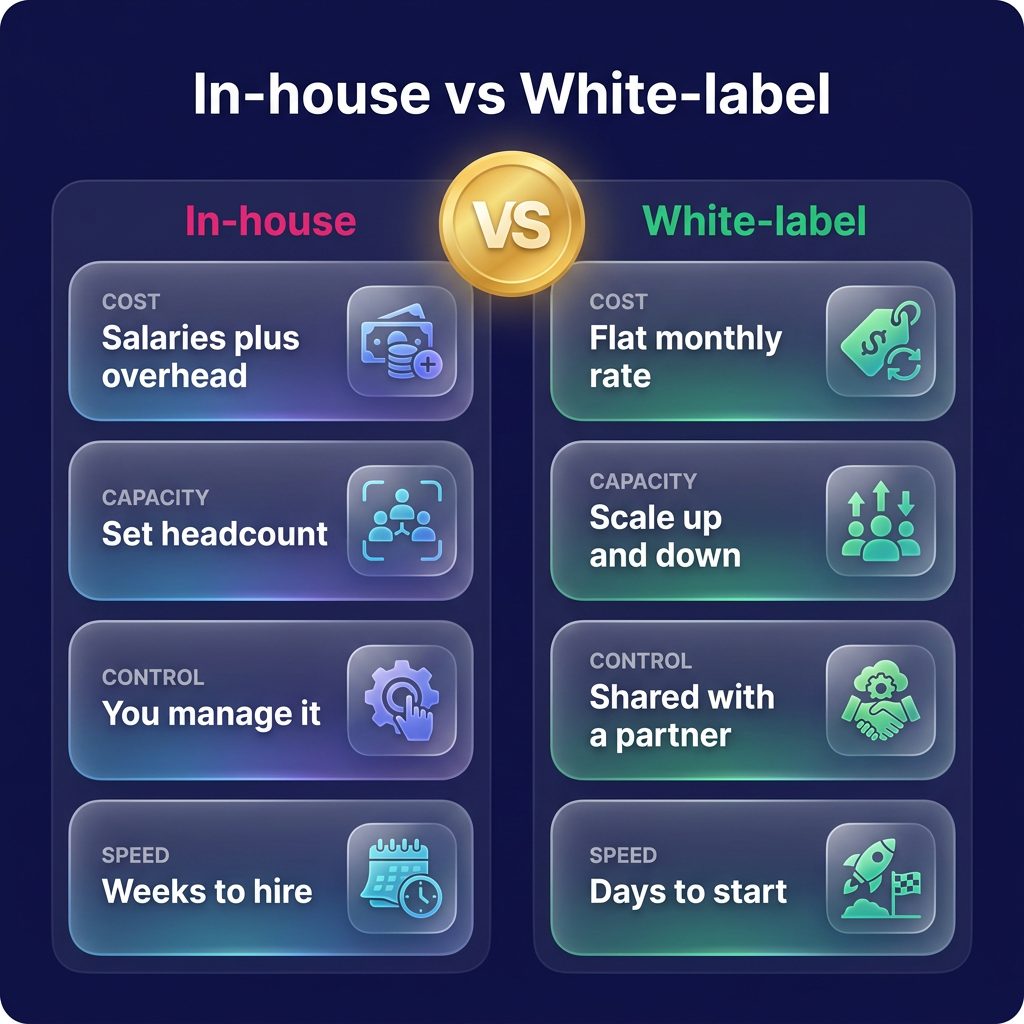
If you need more production capacity, you have two real options: build an in-house team you hire and manage, or plug in a white-label team that does the work under your brand. In-house gives you the most control and the most overhead. White-label gives you flexible capacity and a partner you have to choose well. For most agencies under heavy, uneven workloads, a white-label production team wins on cost and speed, as long as you pick one with a dedicated team and a real account manager instead of a faceless queue.
Table of Contents
I am not neutral here, and I will tell you why up front. I spent over a million dollars getting work done across more than 200 freelancers and shops before building the model I run now. I have lived both sides of this. So let me give you the honest comparison, not the sales-page version.
What does in-house production really cost?
In-house feels like control, and it is, right up until the math hits. A mid-level designer or developer is a salary plus payroll taxes, benefits, software seats, and the management time to keep them busy and growing. Then you find out one person cannot cover design, development, and video at a high level, so one hire becomes two or three.
The hidden cost is the dead time. Agencies have spiky workloads. You win a big client in March and you are slammed. April is quiet and you are paying full salaries to people with not enough to do. You cannot hire and fire to match the spikes without wrecking morale and your reputation. So you either overstaff for the peak and bleed money in the valleys, or you understaff and miss deadlines when it counts. Neither is good.
In-house wins when the work is steady, deeply specialized to your niche, and core to your value. If you are a brand studio whose entire reputation is one signature design style, keep that in-house. For the bread-and-butter production that fills most agency queues, the salary model is a heavy way to buy capacity.
Free 5-Minute Video
See How DeskTeam360 Works in Under 5 Minutes
Watch the short video and see exactly how we handle design, development, and marketing implementation — so you don't have to.
Watch the Video →
What does white-label production really cost?
White-label means the delivery work is done by a partner behind the scenes, and you put your brand on it. You keep the client relationship, the strategy, the reporting, and the pricing. The partner handles execution. Done right, it turns a fixed cost (salaries) into a flexible one (a monthly subscription you scale with demand).
The number that matters is the all-in rate against an all-in hire. DeskTeam360 starts at $1,497 a month, one task at a time, and behind that flat rate you get a full team: two designers, two developers, two technical Virtual Assistants across a day and a night shift for close to around-the-clock attention, a team leader, and a US-based account manager. Compare that to recruiting, onboarding, and carrying even one specialist, and the white-label math usually wins for uneven agency workloads.
The catch is real and worth saying: white-label is only as good as the partner. A cheap overseas queue with a rotating cast will cost you in rework and missed deadlines, even if the sticker price looks great. One of our clients came to us exactly because he was tired of the frustration of working with people overseas and wanted quality work he did not have to redo (his story is in our case studies). The model is not the risk. The wrong partner is.

What about quality and control?
This is the fear that keeps agency owners in-house: if I do not own the team, do I lose control of the quality? Fair question. The answer depends entirely on the structure of the white-label partner.
A faceless marketplace is a real risk, because the person doing your work changes constantly and never learns your brand. A dedicated team is a different story. When the same designers and developers work on your account every week, with a US-based account manager who owns your relationship, they learn your standards once and hold them. You review the work, you give notes, and the team gets sharper over time instead of resetting with every project. That is the difference between renting random hands and plugging in a team.
Control is not about whether the people sit in your office. It is about whether the same accountable people show up for your brand every week and answer for the result. You can get that from a well-built white-label partner, and you keep your overhead flexible while you do.
When should an agency use each?
Use in-house for the steady, specialized, reputation-defining work that is core to why clients hire you. Use white-label for the high-volume production that fills your queue, the overflow when you win big, and the services you want to offer but cannot justify a full hire for yet. Many agencies run both: a lean in-house core for strategy and signature work, and a white-label team for the rest.
The Tobie Group did exactly this. They expanded from an ad agency into a full-service provider by plugging in a team for delivery, instead of trying to hire every capability first (you can read it in our case studies). That is the smart version of this decision: keep what is core, plug in the rest, and grow your service menu faster than your payroll.
If you want the deeper how-to, our guide on how to scale a marketing agency without hiring covers the capacity math, and the piece on the marketing implementation team breaks down exactly who does the work in a plugged-in model.

Free Template
Stop guessing what to hand off. This template shows you exactly what to delegate, how to brief it, and how to QA the results.

Jeremy Kenerson
Founder, DeskTeam360
Jeremy Kenerson is the founder of DeskTeam360, where he leads a full-service marketing implementation team serving 400+ clients over 12 years. He started his first agency, WhoKnowsAGuy Media, in 2013 and has spent over a decade building, breaking, and rebuilding outsourced teams, so you don't have to make the same expensive mistakes he did.